Showing posts with label Outdoor. Show all posts

April 13, 2015

CHAIR NO.14 BY MICHAEL THONET

Since 1859, when chair No. 14 was first introduced, more than 50 million units have been sold all over the world. It is made using a unique steam-bending technology, known as bentwood, that required years to perfect. With its affordable price and simple design, it became one of the best-selling chairs ever made.  Thonet's No. 14 was made of six pieces of steam-bent wood, ten screws, and two nuts. The wooden parts were made by heating beechwood slats to 100 °C (212 °F), pressing them into curved cast-iron moulds, and then drying them at around 70 °C (158 °F) for 20 hours.[3] The chairs could be mass-produced by unskilled workers and disassembled to save space during transportation, an idea similar to flat pack IKEA furniture.

Thanks to its low weight, attractive price and legendary strength, this chair quickly found its place in the cafes of Vienna, earning the nickname the "café chair".

When Michael Thonet first introduced his ‘Consumsessel Nr. 14’ in Vienna in 1859, he could have had no idea that it would become the chair with the highest production run of all time. Since then, the chair, is made of solid bentwood and has been in continuous production by Michael Thonet’s descendants at the firm’s headquarters in Frankenberg, Germany. 

Developed specifically to appeal and be affordableby to broad levels of the population, it was to launch Thonet's international reputation in the 19th century. Today, the company is run by the fifth generation of the Thonet family, direct descendents of Michael Thonet, in Frankenberg in North Hesse, Germany, Thonet's head office.

The chair can be found the world over – in private dwellings or in public buildings – in Asia, Australia, Africa, North- and South America and, of course, in Europe.

Often mispronounced "Tho-nay" the name is pronounced "toe-net" with a hard beginning and ending t.

Chair No 14, today known as 214, is still produced by Thonet.


January 11, 2014

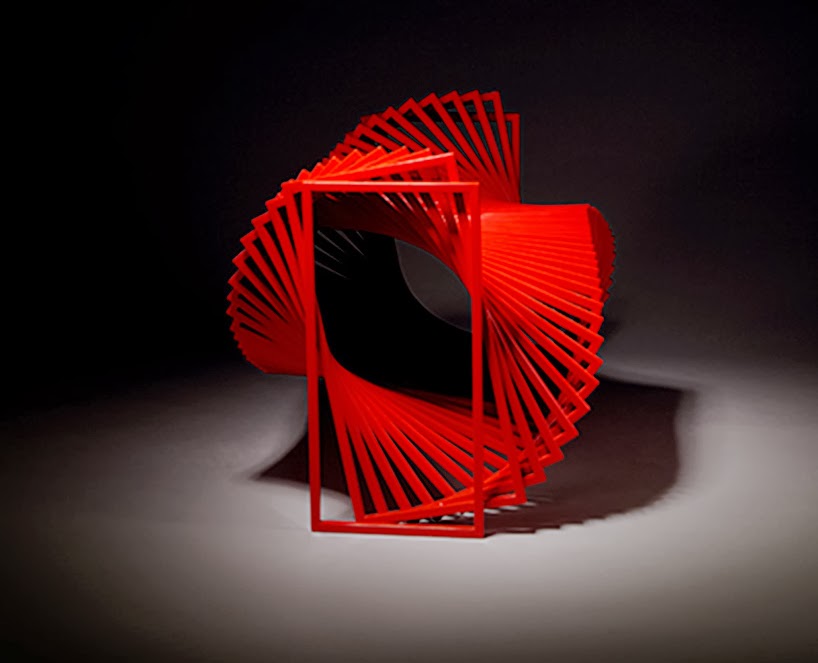
REVOLVING CHAIR by JEON KYUNG

"Rotating straight lines to form a smooth curve, Korean designer Jeon Kyung Ok has created the ‘revolving chair’.The furniture piece consists of multiple rectangular frames, which are gradually off-set one after the other, enabling its structural stability. The moving, wave-like appearance is generated as one recognizes the collection of elements as a whole, as opposed to a series of individual geometric components."


December 5, 2013

Chair made from dowels and elastic by Benjamin Mahler

French designer Benjamin Mahler has created a chair using only dowels and elastic.


November 30, 2013

A Rocking Horse With Roots by David Schellander & Stefanie Richtsfeld

Sitting itself is kinda boring, but design shouldn’t be… it should be fun! That’s the philosophy behind this modern interpretation of the classic Panton chair. To preserving the timeless character of the chair, the designers have avoided decorating it arbitrarily. The chair becomes an integral part of the design, as it would have been intended as a rocking horse by Panton in 1959. Original materials of the chair combined with locally grown wood, (in contrast to the dark fabric & metal) communicate elegance & lightness.

November 14, 2013

LEVELS MODULAR STOOLS BY EELCO VOOGD


September 20, 2013

TRI-TUBE CHAIR BY THINKK STUDIO


August 19, 2013

108 years of Herman Miller in 108 seconds

August 14, 2013

Kachi-Katah Sculpture Chair Design by Masamune Kaji

The interaction the user has with Kachi-Katah is similar to the interaction with Ikebana. It is a Japanese flower arrangement, in which the user and the viewers experience a sense of imperfection, permanence and incompletion. Kachi-Katah is a sculpture that creates a sittable surface. When it is unfolded, the user can compose his environment, changing how it stands and how the blocks of the seatback create negative space.


August 6, 2013

Transform-Barrel-Chair by Transformatori

This is how they do. Good idea what to do with your old barrel. Barrels are plastic and are used for soft concentrate. They found them last year when they used them as barrel light bar tables for these two events:
http://transformatori.net/kapitaltop100/
http://transformatori.net/bidona3/ 

Fresh work of Alexander Todorov, Delcho Delchev and Dimitar Mehanjiev. By transforming barrel into chair they show us, how to make smart and easy chair for our friday party.


For more check out Transformatori Association. 

August 1, 2013

The Best Eames Chairs Designs


DSR chair
Yes, the ubiquitous DSR, and the chair (in white) I’m sitting on to write this. The initials stand for Dining (height) Side (chair) Rod (base). Designed in 1948, the DSR has a distinctive chrome base, giving it the nickname the “Eiffel” chair. It was one of a series, all with the same seat shell, made at first from fibreglass and now, less satisfyingly, from polypropylene. The DSW has a wooden base, the DAW and DAR are armchairs (either with a wooden or rod base) and the RAR (my favourite) is a rocking armchair with a rod base. The original colours were greige, elephant hide grey, parchment and seafoam green


Lounge Chair and Ottoman

I defy anyone to find a seat more comfortable than the Eames Lounge Chair and Ottoman, released in 1956 for the Herman Miller furniture company. Charles Eames’s vision was for something that had the “warm, receptive look of a well-used first baseman’s mitt”, and the result was this blissful embrace of a chair in moulded plywood and leather. Now part of the permanent collection at the Museum of Modern Art, I regret more than I can say the fact that I’ve come to associate it with Peter Mandelson, who was famously photographed disporting himself in one at home in Notting Hill in 1999


La Chaise

This chair, designed for a competition at the Museum of Modern Art in 1948, was inspired by Floating Figure, a 1927 nude in bronze by the French-American sculptor Gaston Lachaise. Made of fibreglass on a base of steel and oak, it is in many ways an uncharacteristic Eames design, being so much more beautiful than it is comfortable; it also proved too expensive to produce until the 1990s when Vitra finally began its manufacture. For those who have space enough for chairs that need never be used, it’s an exquisite statement piece. But for anyone else it’s (literally) a pain in the backside


Eames Lounge Chair Wood 
In 1999, Time magazine declared the LCW the greatest design of the 20th century. The original LCW was born in 1945, of Charles’s work designing plywood splints for the US air force, using curves to mimic the shape of the human leg. After several experiments – plywood split if bent too much – Charles and Ray came up with a model using two separate pieces of plywood joined by a plywood spine. The dream of a single-shell chair was over (Charles and Eero Saarinen had entered one in a competition in 1940, covering any cracks with upholstery). In its place was an “honest” ergonomic chair that was soon coveted the world over


Wire chairs 
Who sits on a wire chair? A man in “difficult” spectacles who fusses about how his espresso is made, and owns 10 shirts all of the same colour and design. Strange, then, that this is an Eames creation. The Eameses were mostly great fun, as you may tell from the famous photograph they took of themselves in which they look to have been pinned to a wall like a couple of insect specimens. They liked jokes, games and collecting things; Ray, in particular, was too much of a hoarder ever to pass as a minimalist. The wire chair (1951) is certainly not a joke. It is, in fact, no fun at all. But it sure looks good against a concrete wall or hard wood floor


Aluminum Group ‘Task’ chair 
An icon of office furniture, though originally commissioned as outdoor seating, with a mesh seat where there is now leather. The Aluminum Group chair went into production in 1958 but has a timeless quality. Not to be confused with its near relative the Lobby chair (1960), designed for the Time-Life building in New York, which Bobby Fischer insisted on sitting on during the 1972 world chess championship in Reykjavik. Furniture firm Herman Miller duly dispatched one for Fischer, and for his opponent, Boris Spassky


June 5, 2013

THEROS CHAIRS BY DANAI GAVRILI